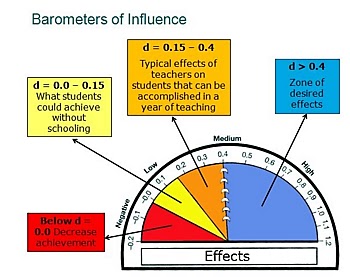
· Student control over learning
I would say that this is 4.0 (medium effect) because it enhances learning by increasing engagement and retention, but also has the risk of students choosing to take no control and not participating. They may also not have the necessary skills to direct their own learning, which means the effect could be negative. It could be 0.2 (low effect).
· Teacher subject matter knowledge
This significantly enhances student learning, so we might think. I believe that teachers can learn what they need to teach and they do not have to be experts if their lessons are well developed. I also believe that students have access to all the information they need to be their own experts. Teachers are really just facilitating opportunity to share. So, I would rank this at 0.1 on the scale (low effect).
· Matching teaching with student learning styles
I would like to think this point has some positive effect on student learning. With appropriate planning and instructional design, students will see a difference in their engagement and motivation levels. They might also leave with a deeper appreciation and understanding of the material. I rate this at 0.4 (medium effect). In doing this kind of matching, lessons may appear to be chaotic, disorganized, unstructured, etc. Students do not always know the theory behind why teachers use some of the techniques they use.
· Reducing class size
I think this has a positive influence on student learning. I would rate this as being 0.6 (high effect) because student would have more one-on-one attention and more time to dig deep and ask questions. The teacher would also have more time and energy to assist.
· Teacher expectations
· Influence of peers
For these 2 points, expectations and peers, I rank them as having a negative influence on the student experience. If the teacher expectations are not aligned with the students, it could cause quite a bit of disconnect between the teacher and the student. I also think that relationships between peers have the same result. If there is lack of rapport, the atmosphere in the class is less conducive to learning. So, I give this a -0.1 (negative effect).
· Providing worked examples
· Cooperative vs individualistic learning
· Teacher-student relationships
For these 3 points, although they are very different in terms of execution, I would rank as being of medium effect at 0.4. They can be achieved relatively easily in the classroom and over spans of time. They can positively affect learning by deepening understanding, increasing engagement, and building stronger relationships.
· Feedback
· Teacher credibility in eyes of the student
This has a high influence and impact on the student experience because I think they are vital in the eyes of students. They need feedback because they cannot improve without it. They also want to trust that the information they receive is valid and they are not entrusting their educations to someone who is not authentic. My rank for these is 0.7 (high effect).
· Student expectations (e.g. self-reported grades)
I would rate this element as highest out of all the rankings I have predicted. The students have the highest impact on their own learning. They can make it or break it. Even if their teachers is an expert, the lesson I give this 1 (high effect).
 coleeducationaldesigns.com