I cannot count the number of times I have walked by a classroom and have seen students having conversations/discussions as a class task.
When taking the the communicative approach to teaching, this would appear to be a good thing. Right?Well, technically this is right, if the teacher has managed to appropriately design the speaking tasks to “communicate through real meaning”
Jose Bowen (2012) suggests that “leading a good discussion that results in the learning outcomes [teachers] want can be much harder than delivering a competent lecture. A small group of prepared, talkative, and comfortable students and an engaging topic can make preparation easier, but striking a balance between guiding the discussion and letting the students discover their own connections is difficult” (196).
In a TESOL class I was teaching last week, a student asked me “how do I know if students have met the objective?” My response to her was “if they can do it.” I explained that students should be able to demonstrate whatever it is that you are teaching.
Knowledge in itself cannot be measured. Application of knowledge can. This same principle relates to speaking activities in the classroom. Just because students are talking does not mean they are improving their speaking.
There are a number of factors that stop students from participating in discussions mentioned by Stephen D. Brookfield (2006) in his book The Skillful Teacher. He believes the problem can be linked to (pgs. 133-141):
- Introversion
- Fear of looking stupid
- Unpreparedness
- Trust issues
- Enviroment
- Past experiences
- Loss of status
- Teacher interjection
- Lack of rewards
Using this structure of Modeling, Guiding, Collaborating and Individualizing, how will you change your speaking tasks to facilitate learning?
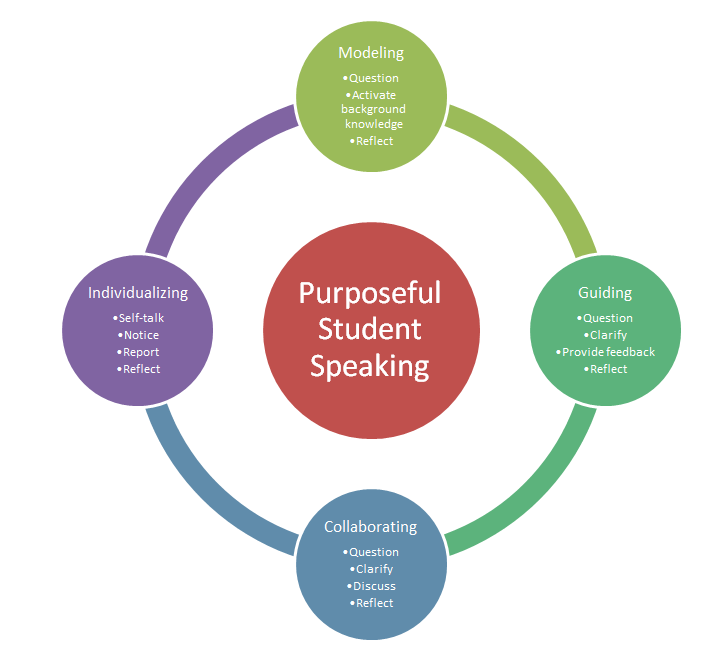 |
| By Shawna Cole |
 coleeducationaldesigns.com